A two-hour generator response can mean two hours to the gate or two hours until the radios are running on generator power. To a buyer comparing cell site backup power solutions, that difference can change the purchase order. The batteries must carry the protected load until utility power returns or another source takes it. A trailer waiting outside a locked compound supplies nothing.
Which backup power solution fits a grid-connected cell site?
Choose batteries alone when their usable reserve covers the outage the site must ride through. Pair batteries with a shared portable generator when a crew and a compatible set can reliably supply the site before that reserve is spent. Choose a fixed standby generator with batteries when extended outages matter and access or fleet availability makes dispatch too uncertain.
| Equipment to quote | When to rule it out |
|---|---|
| Battery only. Retain a suitable rectifier and DC distribution. Add compatible batteries and cabinet space as needed. | The design outage exceeds usable reserve, or the battery cannot recover enough charge between expected outages. |
| Battery + shared portable set. Quote the battery, an engineered inlet and transfer arrangement, and access to a compatible generator, vehicle and crew. | The set cannot get through the gate, is committed elsewhere, or cannot take load before the dispatch deadline. |
| Battery + fixed generator. Quote reserve for the transition, a permanently installed set, transfer controls, fuel supply and service. | The site cannot accommodate the installation or refueling. A fixed set solves the first-trip delay, not an indefinite fuel interruption. |
Before comparing prices, have the engineer name the protected load. At one site that might mean the radio, baseband equipment and backhaul, all on the DC plant. At another, an essential transmission switch might use an AC outlet that goes dead with the utility. More DC battery capacity will not keep that outlet live. Decide whether its supply needs changing, or whether a suitably backed AC output belongs in every bid. Include cooling or other auxiliaries needed to sustain the promised service.
Where solar is already installed, ask what happens if the outage starts after sunset. Solar can help recharge batteries when sunlight returns, but daytime production does not provide the overnight bridge. Likewise, a site that loses its upstream transmission network can have healthy local power and still lose traffic. Buy to a stated site power objective, and record any network dependency separately.
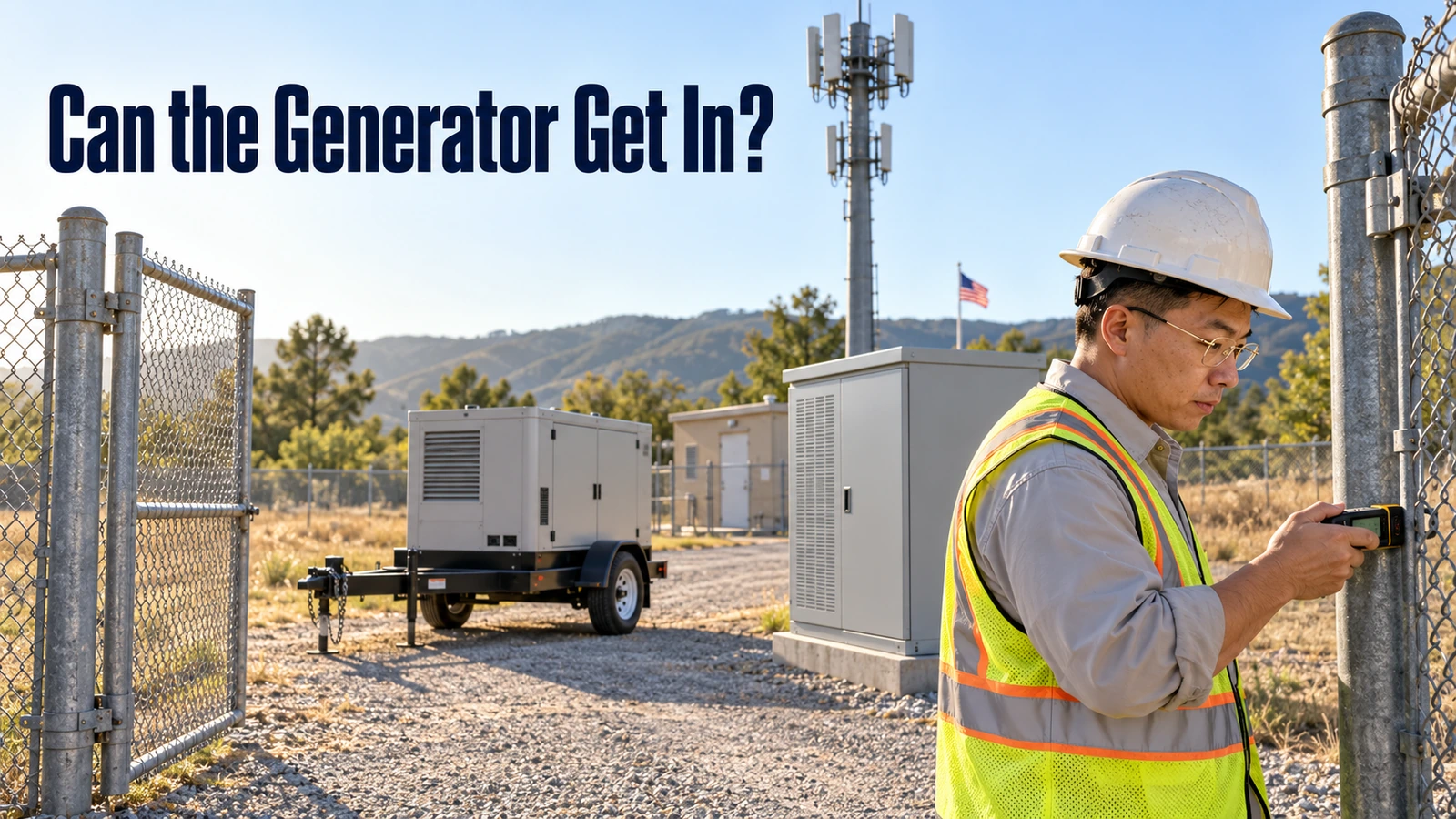
Can a portable generator take the load before the battery runs out?
Start the dispatch clock at utility loss and stop it only when the site has accepted stable generator power. Compare that elapsed time with the usable battery bridge, after subtracting the contingency the operator wants to retain. Do not stop the clock at the first alarm, dispatch acknowledgment, truck arrival or engine start.
There is a practical reason to count the whole trip. In its January 2025 account of communications outages in southwest Virginia, the U.S. Federal Communications Commission reported that providers deployed portable sets to critical cell sites without fixed generators after Hurricane Helene. One provider also described flooded roads limiting access. That United States event illustrates why a normal driving time is a weak basis for a regional outage plan; it does not set a required number of backup hours.
A 150-minute dispatch that passes, and a 250-minute dispatch that does not
Consider a hypothetical site with 270 minutes of usable battery operation at its agreed critical load. Assume the engineer has accounted for starting charge, temperature, end-of-life capacity, conversion losses and the equipment cutoff. This is an assumed operating window, not a cabinet rating. The operator wants 30 minutes left when the next source takes over, so the dispatch deadline is 240 minutes from utility loss to stable generator power.
- 20 minutes: detect the utility failure, confirm the site and release the crew and set.
- 70 minutes: travel from the assigned depot to the compound.
- 35 minutes: gain authorized access and position the trailer.
- 25 minutes: the qualified team completes the approved connection and transfer checks; the site accepts the generator supply.
The normal callout takes 150 minutes, leaving 90 minutes of margin against the 240-minute deadline. Now assume regional demand adds 100 minutes before a crew and set are released. Stable power arrives at minute 250. The batteries would still have 20 minutes on these assumptions, but the plan misses the specified reserve by 10 minutes. A bid promising arrival within two hours would not resolve that shortfall.
That result changes what to buy. For an accessible, lower-priority site, obtain a guaranteed allocation or price the extra usable reserve and confirm it can be recharged. For a hub that cannot wait for that allocation, price a fixed set. If two sites lose power together and only one trailer exists, do not give both the same dispatch time. Once connected, that trailer stays at the first site until another supply can relieve it. A second driver is not a second generator.
What belongs in the battery cabinet quotation?
Specify the power to be delivered at the protected feeders and the time it must last. Then ask the supplier to identify the actual battery modules, protection, distribution and environmental controls included in the cabinet. A quotation for an enclosure or a maximum storage capacity is not yet a quotation for hours of service.
For example, Huijue’s HJ-ZB outdoor site battery cabinet family lists 15 kWh maximum storage for the HJ-ZB15 and 30 kWh for the HJ-ZB30. Those figures distinguish configurations. They do not say how many modules a particular bid includes or how long either unit will carry your radios. Ask for usable energy at the agreed load and conditions; use the telecom battery runtime calculation if different assumptions are producing different bids.
For a retrofit, send the existing plant’s output voltage range, spare distribution capacity and permitted battery interfaces. Check that the rectifier can supply the live site and the agreed recharge current when utility or generator power is back. Otherwise a larger battery may improve the first outage while leaving the second one underprotected. If the existing plant lacks charging capacity, include the rectifier and distribution upgrades from the site power equipment range in the comparison. On a generator-backed bid, check the combined running and recharge demand against the offered set under actual site conditions.
Give procurement two comparable totals for the same protected service: the installed price and the cost to keep the option available over the same stated period. For a fixed set, identify site preparation, transfer equipment, maintenance and fuel arrangements. For a portable set, separate the standby retainer or fleet cost from mobilization, after-hours labor and fuel. List who owns the inlet, transfer work, fuel and first callout. None of these is implied by ordering a battery cabinet.
What should the project manager accept at handover?
Ask for evidence at the load, not just at the generator. A cabinet factory test can document the configured equipment and selected electrical functions. A site exercise can demonstrate that the local transfer arrangement works; only a timed mobilization exercise also tests the dispatch promise. Agree beforehand what the service team will monitor and who can stop the exercise.
For battery-only sites, agree how usable reserve will be demonstrated without deliberately interrupting live service. A controlled load-bank test or other agreed evidence should state the starting charge, load, temperature, elapsed time and endpoint. Check the recharge record against the interval before the next design outage. A brief loss-of-mains drill may show that the battery takes over; it cannot prove several hours of reserve.
For a fixed set, witness the approved loss-of-source and return sequence with qualified personnel. Record whether the protected radio and backhaul loads stayed up, when the source was accepted, and how charging resumed. Use the existing guide to battery takeover and grid return for the electrical sequence. A successful start with no site load proves less than a successful transfer.
For a portable set, add dispatch, gate arrival, access and load acceptance timestamps to the same record. If the trailer was on site before the test began, label the result a transfer test and leave dispatch unverified. If the set carried the load on time but the backhaul switch rebooted, record the power transfer as successful and the service-continuity criterion as failed. That distinction tells the contractor what to fix before sign-off.
Request a backup configuration for one representative site
Send Huijue the site’s critical AC and DC loads, current rectifier and batteries, and recent outage history. If a mobile generator is an option, give two times from utility loss to accepted load: one for an ordinary callout and one for a regional outage. Say whether each was measured, promised in a contract or is still unknown. Ask for a battery-only or generator-ready cabinet quotation with the proposed reserve, retained equipment and generator or dispatch exclusions shown separately.
Request a cell site backup quote