PROCUREMENT COMPLIANCE
Does White-Labeling Chinese Telecom Equipment Solve Procurement Restrictions?
Changing the badge may simplify branding and local support. It does not, by itself, change who made the equipment, where it originated, who controls its software or whether a procurement restriction applies.
Updated July 31, 2026
Buyer and compliance guide
Approx. 14-minute read
The Short Answer: Usually No
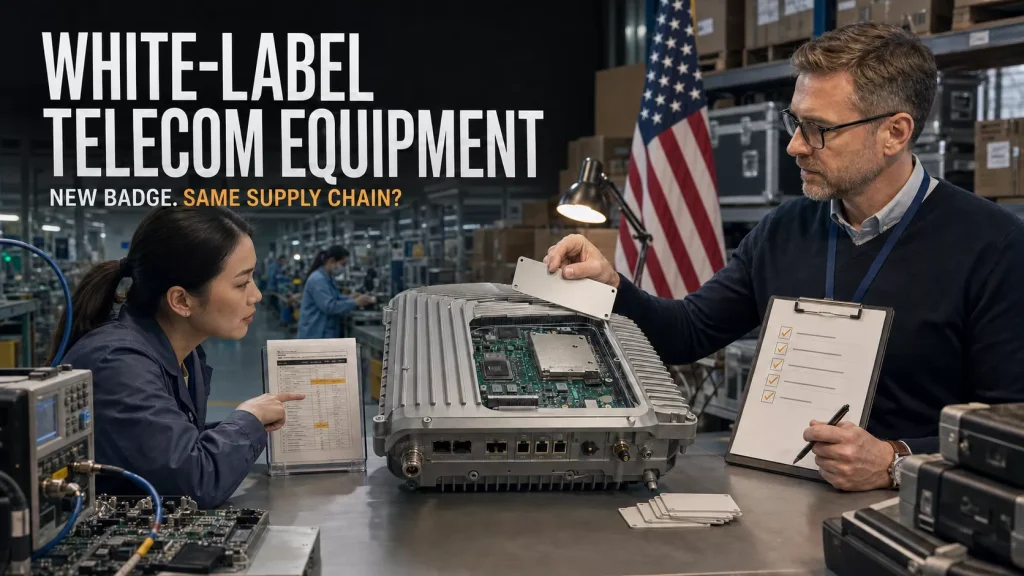 A box arrives with a local brand, a new model number and a polished English manual. Inside, the PCB is unchanged, the firmware still comes from the original factory and remote support still passes through the OEM. At that point, the procurement team has to stop reading the front label and reconstruct the product behind it.
White-labeling Chinese telecom equipment does not normally cure a restriction that follows the original producer, an affiliate, the production location, a critical component, the software provider or the country of origin. The new logo changes how the product is sold. It does not erase its engineering history.
There is nothing unusual about private-label or original-design-manufacturer programmes. Done properly, they can provide local stock, local-language documentation, a consistent product range and a service counterparty in the buyer’s market. Trouble starts when the label is expected to conceal an OEM, carry an ineligible product into a tender under a new name or support an origin claim that the manufacturing record cannot.
So the awkward question is not, “Whose logo is on the enclosure?” It is:
Which entities designed, manufactured, assembled, certified, programmed, updated and remotely supported this exact model?
This is a practical procurement framework, not legal advice. The answer can change with the jurisdiction, buyer, network function, funding source and contract. Before award, confirm the current rule set with the contracting authority or qualified counsel.
A box arrives with a local brand, a new model number and a polished English manual. Inside, the PCB is unchanged, the firmware still comes from the original factory and remote support still passes through the OEM. At that point, the procurement team has to stop reading the front label and reconstruct the product behind it.
White-labeling Chinese telecom equipment does not normally cure a restriction that follows the original producer, an affiliate, the production location, a critical component, the software provider or the country of origin. The new logo changes how the product is sold. It does not erase its engineering history.
There is nothing unusual about private-label or original-design-manufacturer programmes. Done properly, they can provide local stock, local-language documentation, a consistent product range and a service counterparty in the buyer’s market. Trouble starts when the label is expected to conceal an OEM, carry an ineligible product into a tender under a new name or support an origin claim that the manufacturing record cannot.
So the awkward question is not, “Whose logo is on the enclosure?” It is:
Which entities designed, manufactured, assembled, certified, programmed, updated and remotely supported this exact model?
This is a practical procurement framework, not legal advice. The answer can change with the jurisdiction, buyer, network function, funding source and contract. Before award, confirm the current rule set with the contracting authority or qualified counsel.
What a White Label Changes – and What It Does Not
“White label” covers a surprisingly wide range of arrangements. At one end, a reseller changes the logo and translates the manual. At the other, a brand owner writes the requirements, approves components, controls a firmware branch and holds the certification file. Calling both products private label hides the detail that matters most in procurement: who has design authority, and who can change the product after award?
| Product attribute |
Can a white-label agreement change it? |
What the buyer should verify |
| Visible brand and model name |
Yes |
Trademark owner and model cross-reference |
| Sales contract and local warranty |
Yes |
Which legal entity accepts claims and holds spares |
| Original designer or manufacturer |
No, unless production responsibility genuinely changes |
OEM, ODM, assembler and major subcontractors |
| Country of origin |
Not by relabeling alone |
Origin analysis and manufacturing operations by country |
| Firmware codebase and signing keys |
Only through real technical control |
Repository ownership, build process and key custody |
| Cloud or remote-support path |
Only if the architecture is changed and tested |
Endpoints, data flows, administrator roles and fallback operation |
| Existing regulatory status |
Sometimes a new filing is required; the underlying facts remain |
Certificate holder, grantee code, reports and model identity |
| Restricted-entity involvement |
No |
Ownership, affiliates and responsibility for major production stages |
A sticker is cosmetic. A controlled ODM programme is operational. The paperwork, test records and change history should make the difference obvious.
First Identify the Restriction You Are Trying to Satisfy
In tender meetings, the word “ban” often gets used for several rules that work in quite different ways. Until the buyer identifies which rule is actually in play, nobody can give a reliable answer on eligibility.
| Restriction type |
What it follows |
Why a new label may fail |
| Named-entity restriction |
Producer, provider, subsidiary, affiliate or designated corporate group |
The original entity remains involved behind the local brand |
| Covered-equipment restriction |
Equipment produced by a named entity or falling within a covered category |
The physical device remains the same covered equipment |
| Country-of-origin or local-content rule |
Manufacturing location and the applicable origin test |
Repackaging and a new badge do not normally create substantial transformation |
| Network-security rule |
Function, trust boundary, supplier risk, software access and network criticality |
The same firmware, remote service and privileged access remain |
| Government-contract clause |
Contractor representations, equipment use and supply-chain obligations |
The prime contractor remains responsible for lower-tier products |
| Product-conformity rule |
Party placing the product on the market under its name |
The local brand may acquire more responsibility rather than less |
This is where discussions often drift to opposite extremes. One team treats every Chinese-made telecom part as prohibited. Another treats a non-Chinese reseller as a complete cure. Neither position survives a careful reading of the applicable clause.
Function matters as much as the product category
A steel cabinet or mounting frame does not have the same access to a network as a router, radio, core-network function or cloud-managed gateway. A solar controller is usually operational technology rather than traffic-carrying telecom equipment. Add a cellular modem, remote administrator account or vendor update service, however, and a new trust relationship appears.
Tender language can also be broader than the underlying statute. A tower company may impose an origin policy beyond the legal minimum. A development-bank project may attach funding conditions. A public-safety network may define critical components more strictly than a private warehouse network. The only dependable starting point is the actual clause, including its definitions and flow-down requirements.
How Major Procurement Markets Treat the Issue
United States: the FCC has addressed white labeling directly
The clearest published answer comes from the US Federal Communications Commission. In its equipment-authorization security order, the FCC stated that rebranding or white labeling covered equipment does not change whether the equipment is covered. The Commission also took a broad view of equipment “produced by” an entity on the Covered List. Design, manufacturing, assembly and development can all matter, and more than one company may carry production responsibility.
The relevant language appears in the FCC’s Second Report and Order on equipment authorization and national-security threats. For a US radio-frequency product, check the FCC ID, grantee, filing exhibits, internal and external photographs, operational description and any private-label authorization history. A new model number on an invoice tells very little on its own.
US federal procurement: follow the covered component, not the carton
US federal contracting adds a separate layer. FAR 52.204-25 addresses covered telecommunications equipment or services used as a substantial or essential component or as critical technology, subject to stated exceptions and waivers. It also contains reporting duties.
This is not a universal prohibition on every Chinese component in every private project. It is a contract rule with a defined scope. A prime contractor still cannot base its representation on the distributor’s logo. It needs a reasonable inquiry into the equipment being supplied and, depending on the clause, the equipment used by the contracting entity.
For a white-label tender, the compliance team should map:
- The private-label seller and every relevant affiliate.
- The OEM, ODM, assembler and certificate applicant.
- Covered modules or services inside the finished system.
- Whether a component is substantial, essential or critical to system function.
- Exceptions, waivers and reporting paths stated in the contract.
European Union: a private label can increase legal responsibility
The EU does not operate one identical telecom-vendor rule for every Member State and every network. National-security measures, 5G supplier controls, public-tender terms and product rules must be checked separately.
Europe adds a twist that many reseller agreements miss. Under EU product-compliance guidance, an importer or distributor that markets a product under its own name can take over manufacturer responsibilities. The European Commission’s guidance for importers and distributors says the own-brand party needs sufficient information about design and production because it assumes legal responsibility when affixing the CE marking.
In practical terms, a European white-label owner should be able to produce the applicable declaration of conformity, technical documentation, risk assessment, standards list, test evidence, traceability records and corrective-action process for the finished product. A folder of certificates bearing another model or another applicant is not a substitute.
CE marking and telecom-supplier eligibility answer different questions. CE documentation can support product conformity; it does not by itself prove that a product is acceptable for a restricted 5G network, government contract or critical-infrastructure policy.
United Kingdom: examine the designated vendor and supply path
UK telecom-security measures can restrict goods, services or facilities associated with a designated vendor or corporate group. The local badge does not settle whether that vendor supplied, provided or made the product available. It does not remove the operator’s security duties either.
Scope still needs care. A direction written for a public communications network should not be copied automatically into every private radio project. But the review cannot stop at the visible brand. It should follow the original producer, software support route, network function, procurement date and wording of the relevant direction.
Three White-Label Models – Only One Is a Simple Sticker
On a quotation sheet, three privately branded products may look much the same. Behind the label, their commercial relationships can be entirely different. The depth of documented control determines how much confidence the new brand deserves.
| Model |
What the brand owner controls |
Compliance value |
Buyer view |
| Cosmetic relabel |
Logo, packaging and sales channel |
Very limited |
Treat as the original product until proven otherwise |
| Managed ODM programme |
Requirements, selected components, tests, documentation and change approval |
Useful where the OEM is eligible and fully disclosed |
Verify control through records, not contract language alone |
| Independent product programme |
Architecture, software branch, signing keys, certification, supplier approvals and lifecycle support |
Potentially strong, but production history still matters |
Assess the full evidence file and applicable restrictions |
Cosmetic relabel
The reseller buys a finished unit, changes the logo and perhaps translates the manual. Firmware, cloud service, test reports and the internal model identity stay with the OEM. There is nothing inherently wrong with that in an unrestricted market. It answers a branding question, though, not a provenance or supplier-control question.
Managed ODM programme
The brand owner writes the specification, approves the bill of materials, witnesses validation and controls engineering changes. The OEM remains visible and responsible for production. This arrangement can improve consistency and local service, provided neither the OEM nor the product is ineligible for the intended procurement. The records should show that control in practice; the words “custom ODM” on a sales slide do not.
Independent product programme
Here, the brand owner controls design authority, the source or build environment, software-signing keys, vulnerability response, certificate application and approved suppliers. This is closer to a product company using contract manufacturing than to a reseller applying a badge. Production may still occur in China, and that fact remains relevant where a rule follows the production country or a listed entity’s substantial responsibility.
The Evidence File a Buyer Should Request
By the time bids are commercially scored, the OEM relationship should no longer be a mystery. Ask for one model-specific evidence package, rather than accepting a chain of email assurances.
- Corporate identity map: seller, trademark owner, importer, OEM, ODM, assembler, software provider and relevant affiliates.
- Product genealogy: original model, private-label model, hardware revision and certificate cross-reference.
- Manufacturing route: factories, major production stages and countries where each stage occurs.
- Origin position: the supplier’s documented basis for the claimed country of origin; obtain a formal ruling where the procurement risk warrants it.
- Hardware bill of materials: processor, radio modules, secure element, storage, network interfaces and critical power components.
- Software bill of materials: operating system, third-party libraries, update agents, cryptography and known-support periods.
- Firmware control: source ownership, build environment, signing-key custody, update approval and rollback process.
- Remote-service map: cloud endpoints, DNS names, telemetry, administrator paths, data location and offline capability.
- Regulatory records: exact-model test reports, certificate holder, declarations, labels and permitted family variations.
- Change control: components or firmware that may change, advance notice period and buyer approval rights.
- Security operations: vulnerability disclosure, patch service levels, incident notification and end-of-support policy.
- Commercial accountability: warranty provider, local spares, recall responsibility, insurance and audit access.
Two records deserve special attention. Model genealogy shows whether the new name is merely a barrier to a database search. Signing-key custody shows who can place executable code on the installed device after the tender is over.
If the supplier needs a week to discover which factory signed the firmware, that delay is useful information. It may reflect an immature document system rather than deception, but either way the buyer has found a lifecycle risk before deployment.
Test the disclosure against the product
Follow the paper review with a sample inspection. Compare PCB identifiers, boot messages, MAC address allocation, the certificate chain, web interface, firmware package and radio filing with the declared OEM. Old brand strings in manuals or update files are not automatically a problem; unexplained ones are. Review outbound connections in a controlled network as well.
These checks do not prove the absence of every hidden relationship. They do show whether the supplier’s basic disclosure is consistent with the equipment in front of you.
Contract Clauses That Make the White Label Auditable
A statement reading “compliant with all laws” sounds reassuring and does very little operational work. The contract should turn the evidence gathered during due diligence into continuing obligations.
| Clause topic |
Useful requirement |
| OEM disclosure |
Name every entity responsible for design, manufacture, assembly, firmware and remote service |
| No undisclosed substitution |
Prohibit changes to critical components, factories or software providers without prior approval |
| Restricted-party warranty |
Define the lists, affiliates, ownership threshold and review date rather than using a vague promise |
| Model continuity |
Link the quoted model, tested model, certified model and delivered revision |
| Software control |
State update authority, signing-key control, support period and vulnerability-notification timing |
| Data path |
Disclose telemetry, remote access, subprocessors, hosting locations and buyer disablement options |
| Audit and records |
Preserve technical and supply-chain records and permit proportionate verification |
| Change in status |
Require prompt notice if an entity, component or service becomes restricted |
| Remedy |
Define replacement, transition support, refund, indemnity or termination rights |
Avoid demanding that a supplier certify the absence of every Chinese component unless the project genuinely requires that standard. The promise may be impossible to verify and could exclude ordinary power supplies, semiconductors or passive parts without improving the relevant security outcome. Define the restricted function and legal basis first.
Four Worked Procurement Scenarios
Scenario 1: a covered router receives a local brand
Imagine a distributor importing a finished router made by an entity covered by the applicable FCC rule. The enclosure badge and product page change, but the hardware, firmware and OEM support do not. The result is straightforward: the white label does not change the underlying covered-equipment status. The bid cannot proceed on the theory that the distributor has become the producer.
Scenario 2: an unlisted Chinese ODM builds a private industrial gateway
Now change the facts. A European integrator owns the requirements, controls the software branch and signing keys, holds model-specific documentation and uses an unlisted Chinese contract manufacturer for a private industrial gateway. Chinese manufacture is one relevant fact, not the conclusion. The buyer still checks national restrictions, origin, product conformity, software governance and the contract. In the EU, the own-brand company may also carry manufacturer responsibilities.
Scenario 3: a solar power cabinet includes a cellular monitoring modem
Site-energy equipment is less tidy. Consider a cabinet that supplies DC power, solar control and battery backup while a cellular modem reports alarms. The enclosure and power electronics do not route telecom traffic, but the modem has its own producer, firmware and authorization.
The useful review follows the modem rather than the cabinet’s paint or marketing category. Identify it, check whether it is restricted or contractually excluded, decide whether it performs a critical function and test local operation with the modem disabled. A federal contract, public communications network and private tower may reach different answers on the same cabinet.
Scenario 4: a passive outdoor cabinet is privately labeled
A local distributor sells a Chinese-made steel enclosure under its own brand. There is no modem, processor, firmware or remote service. A restriction written for active network equipment may not apply at all, although structural, environmental, origin, product-safety and tender requirements still might. Extending a radio-access restriction to unrelated passive metalwork needs a policy basis, not a hunch.
Taken together, the four cases explain why site-energy projects need a function-by-function review. One cabinet can combine passive metalwork, batteries, rectifiers, a controller and communications modules from different suppliers. Compliance should follow the components and functions addressed by the governing rule, not the marketing name of the assembled system.
A Nine-Question Decision Test Before Award
At this point, the procurement team should be able to answer nine questions without going back to the sales brochure:
- What exact law, list, funding condition or contract clause creates the restriction?
- Does it follow a named entity, an affiliate, a product function, a production location or the buyer’s own use?
- Who originally designed, manufactured, assembled and developed the delivered model?
- Is the white-label model technically identical to another model, and can the supplier prove the relationship?
- Who owns the firmware branch, signing keys, cloud service and administrator access?
- What is the documented country of origin, and does the applicable rule use the same origin test?
- Who holds the regulatory filing and the complete technical file?
- Can the supplier notify and manage a component, ownership or restricted-list change during the product life?
- Would the procurement team be comfortable disclosing the OEM relationship to the authority or end customer?
If the ninth answer is no, the label is probably being asked to do work that evidence should be doing.
Procurement rule of thumb: treat an undisclosed OEM as an unresolved compliance finding, not as proof of illegality and not as proof of eligibility. Pause commercial approval until the producer, model genealogy, firmware control and relevant restriction have been matched.
Use white labeling to assign responsibility, not to hide it.
A sound private-label programme gives the buyer a clear contract party, controlled changes, usable documentation and local support. Most importantly, it makes the original supply chain easier to explain when an auditor asks.
Could your supplier reconstruct the full product history for one delivered serial number without asking the factory to rewrite the answer?