Global telecom energy solutions [email protected] Phone / WhatsApp: +86 13764881846 Project inquiry
HUIJUE GROUPENERGY CREATES A BETTER LIFE
POLICIES & REGULATIONS

Telecom Solar in Dubai: Hosting Accounts and Shams Dubai Credit Allocation

Map the rooftop, electricity accounts and telecom load before assigning solar savings. Follow a worked credit-allocation example and identify the approvals a Dubai project still needs.
A telecom operator can lease rooftop space, pay for a solar installation and still lack the account arrangement needed to receive its expected electricity-bill benefit. Roof access, equipment ownership and a DEWA consumption account are separate records. Resolve their relationship before putting a solar credit into the telecom project’s financial model. For Shams Dubai credits, the practical question is which approved electricity account receives an offset. Start with the bill supplying the radio equipment, not the PV array drawing. This guide concerns DEWA’s Shams Dubai arrangements in Dubai; it does not establish eligibility under another UAE utility or solar programme.

Put the electricity bill beside the site lease
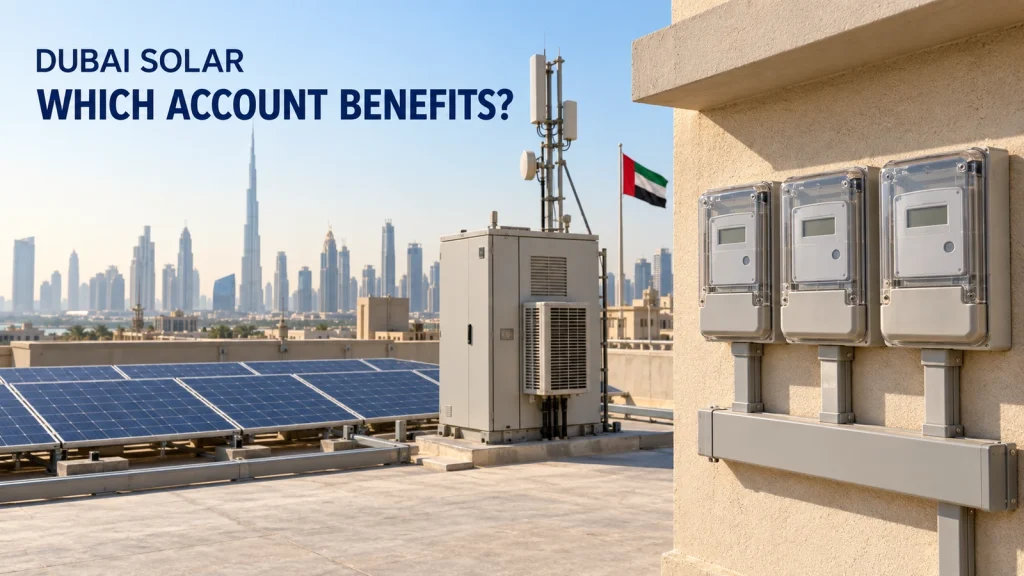
Illustrative Dubai rooftop with solar panels, a closed telecom cabinet and metering equipment, accompanied by the UAE flag. Ask the operator’s facilities team for the actual supply bill and the electrical drawing showing the telecom feeder. Then ask the property team for the roof-access agreement. A mismatch between those documents can invalidate a savings assumption without changing the available sunshine or panel area. The hosting account is the electricity consumption account associated with the connected solar generator. It is not the commercial agreement under which a tower company hosts radio equipment. Use different field names for the two records so that an equipment-hosting reference is never copied into a utility application. Build a short account map. The following is a project-review aid, not a substitute for DEWA’s application documents.
Record Identify Question it resolves
Telecom supply bill Account holder, account reference and the premises supplied Whose bill currently includes the telecom consumption?
Solar connection proposal Proposed hosting account and connection point Where will the generator enter the electrical installation?
Site and property records Official plot reference and roof-access permissions Which land boundary and installation rights are being relied on?
Candidate receiving accounts Account identity, holder, load served and existing generation Which accounts need eligibility confirmation?
Telecom cost allocation Direct billing, submetering or another charging arrangement How would any verified benefit reach the project budget?
Account records may identify a different legal entity from the trading name on the building. Record the exact holder and have discrepancies resolved through the appropriate customer process. Do not treat a shared corporate logo as proof that accounts can be grouped.

Which accounts can receive Shams Dubai surplus?

DEWA’s published credit-transfer service requires receiving accounts to share the hosting account’s holder and plot. The receiving account must also be without its own connected renewable generator. Project acceptance still needs confirmation. The Shams Dubai Credit Transfer service is the current administrative reference for identifying and requesting receiving accounts. Proximity alone is insufficient: a radio installation across the street is not made eligible by being managed from the same office. For a telecom estate, an account map should be checked site by site. A network-wide electricity spreadsheet is useful for planning, but its aggregation can hide different account holders, plot references and contractual relationships. Keep unconfirmed recipients outside the committed savings case until the responsible parties resolve them. A single-host arrangement also needs careful terminology. Having no additional receiving account does not, by itself, mean that the solar project is ineligible; it means the multi-account transfer question is not the same question as connecting the generator.

How does the hosting account affect the telecom credit?

The host is settled first; remaining eligible surplus moves through the approved receiving-account sequence. A telecom account later in that sequence may receive less than the export meter records. Section 2.4 of DEWA’s Connection Conditions, Version 4.1, November 2025, sets out the billing method. This was the version linked from DEWA’s publications index when reviewed on September 21, 2026. Do not label the document a new 2026 regulation simply because it was checked this year. Consider a fictional operator-owned compound. Assume DEWA has accepted the account arrangement, all three accounts satisfy the applicable conditions and there is no opening surplus. Account H hosts the generator. Account F supplies an equipment-support building; Account T supplies the telecom installation. These labels and figures are invented for the example.
  1. During the same billing period, H records 1,600 kWh imported and 2,800 kWh exported. After its own netting, 1,200 kWh remains.
  2. F comes next and has 700 kWh of consumption. Applying 700 kWh leaves 500 kWh available.
  3. T has 900 kWh of consumption and receives the remaining 500 kWh. Its residual energy consumption for this simplified calculation is 400 kWh.
The telecom planning team cannot assign the whole 2,800 kWh export to T. In this example, the amount reaching T’s settlement is only 500 kWh. Nor should the team substitute gross PV production for export: energy used behind the host’s meter does not appear in the export register. The offsetting sequence changes the allocation. If T were placed before F in an approved alternative, the same 1,200 kWh would cover T’s 900 kWh, leaving 300 kWh for F and 400 kWh of F’s consumption unmatched. Total offsets are unchanged here; the account receiving them is different. This is a kWh walkthrough, not an AED quotation or a reproduction of a DEWA bill. It excludes tariff slabs, minimum-charge provisions, taxes and other bill items. It also assumes aligned periods and no estimates or corrections. Use the actual account tariffs and full bills before making a commercial comparison; a zero residual kWh figure is not a promise of a zero invoice. Test a second month with different building loads. If a receiving account’s consumption falls during a shutdown, the distribution of benefit can change even with the same PV output. A project model should preserve each account’s consumption profile instead of treating all loads as one annual number.

Can a rooftop telecom tenant use the landlord’s solar credit?

A roof lease does not establish that right. DEWA distinguishes different customers’ accounts, and its conditions reject producer arrangements that rent space so tenants can use the producer’s Shams Dubai electricity. Obtain a project-specific determination before relying on the arrangement. Several superficially similar installations therefore need different reviews. An operator owning both the premises and its electricity accounts presents one account map. An operator leasing a roof while holding a separate utility account presents another. An operator receiving a property manager’s invoice based on a private submeter presents a third. A site photograph cannot identify which relationship applies. A telecom submeter can help allocate measured consumption internally, but it is not evidence that DEWA has accepted a separate receiving account. Ask who issues the electricity invoice, who can authorize changes and who retains the underlying meter records. Keep the answer separate from the engineering observation that a cable feeds the telecom cabinet. Do not treat a landlord discount, an internal recharge entry or a revised lease clause as automatic approval of a solar-sharing arrangement. Have the property owner, account holder, telecom operator and qualified project adviser resolve the model with DEWA. This article is a screening guide, not a legal opinion on a particular tenancy.

Keep billing, physical supply and backup in separate files

The account map answers where an offset is recorded. The electrical single-line diagram answers which source can feed the telecom load. The outage design answers what happens when the utility supply is unavailable. A favourable answer in one file does not complete the other two.

Billing evidence

Retain account assignments, the accepted sequence and the relevant bills. Match their periods before comparing the project forecast with the recorded result. An inverter’s monthly generation screen cannot explain every difference in an account settlement.

Electrical evidence

Show the PV interface, utility boundary and telecom feeder in the approved drawing. Identify whether the project concerns a building-connected solar generator, a dedicated telecom energy platform or an interface between them. The telecom solar power architecture guide owns that equipment-level design decision.

Continuity evidence

A monthly credit has no stored electrical energy that a rectifier can draw during an interruption. Maintain a separate specification for the critical load, battery reserve and permitted source behaviour. The telecom battery backup operating guide explains the outage sequence; no autonomy duration is implied by this billing example. Any proposed operating mode needs the applicable connection and design approvals.

Account changes belong in the project risk register

Unused surplus can roll forward, but is not a cash receivable or a credit transferable to another plot. Closing the host forfeits the balance; transferring the generator to a new owner or tenant does not transfer that balance. Review section 2.4 before a property handover. Make account closure a named event in the telecom relocation plan. A network project manager may know the radio shutdown date while the finance team separately schedules a final utility bill. Without coordination, a model can continue showing value from a credit attached to an account that is about to close. Record who approves recipient changes. DEWA publishes a 90-day restriction on further changes after approval, with offsetting scheduled from the next billing cycle. An application acknowledgement should not be booked as a completed transfer; reconcile the subsequent bill. For mixed-use compounds, screen unusual recipients before including their demand. Public-EV-charging accounts are excluded as secondary surplus recipients under the current conditions. Do not assume that every electricity account in a property portfolio is available to absorb credits. Keep a dated snapshot of the forecast whenever an account or tenancy changes. This lets finance distinguish a generation shortfall from a change in which account benefits. The corrective action could be a revised project budget or an account review, rather than replacing working PV equipment.

Release only the assumptions that have owners

Before ordering equipment, bring the site drawing and account map into the same review. Assign an owner to each open issue: the account holder confirms utility records, the property team resolves access rights, the appointed solar consultant handles the proposed connection, and the telecom engineer defines the critical-load interface. A supplier quotation should state which inputs remain provisional. The commercial handoff should contain an account-specific benefit calculation, not just an annual PV yield. Keep the opening balance, measured import and export, receiving consumption and allocation order visible. Place expected monetary benefit in a separate calculation using the applicable tariff and charges. Have the customer approve both the assumptions and the treatment of changes. Credit allocation is only one part of project acceptance. Capacity, equipment, installation and connection requirements remain subject to their applicable review. Neither this article nor a cabinet specification establishes DEWA project approval or an equipment supplier’s enrolment.

Define the telecom interface after the account review

For a Dubai telecom energy proposal, provide Huijue with the load schedule, site electrical drawing, intended PV interface, backup objective and the connection boundary confirmed by the customer and its appointed adviser. Share an anonymized account-role map where useful; credentials and unredacted bills are not needed for preliminary equipment discussions. DEWA and the responsible project parties determine account and connection acceptance. Discuss the Dubai telecom energy interface