Global telecom energy solutions [email protected] Phone / WhatsApp: +86 13764881846 Project inquiry
HUIJUE GROUPENERGY CREATES A BETTER LIFE
PRODUCT KNOWLEDGE

How Solar and Batteries Power GSM/LTE Sites Day and Night

Understand how solar generation and stored energy share a base station’s everyday load, and why abundant sunshine alone cannot establish continuous supply.
Solar photovoltaic (PV) generation and battery storage can form the normal power supply for a GSM/LTE base station. When usable solar output exceeds the running load, it can power the equipment and charge the battery. When solar output falls below demand, stored energy can make up the difference. After sunset, the battery can carry the load until another usable source becomes available. The radio equipment therefore does not need sunlight at every moment. It needs a complete supply system capable of delivering its required power while generation changes. For autonomous base stations, that means considering the operating load, local solar conditions and usable stored energy together. Permanent service is the intended duty; actual continuity depends on whether the system can sustain that duty through the conditions for which it was designed.
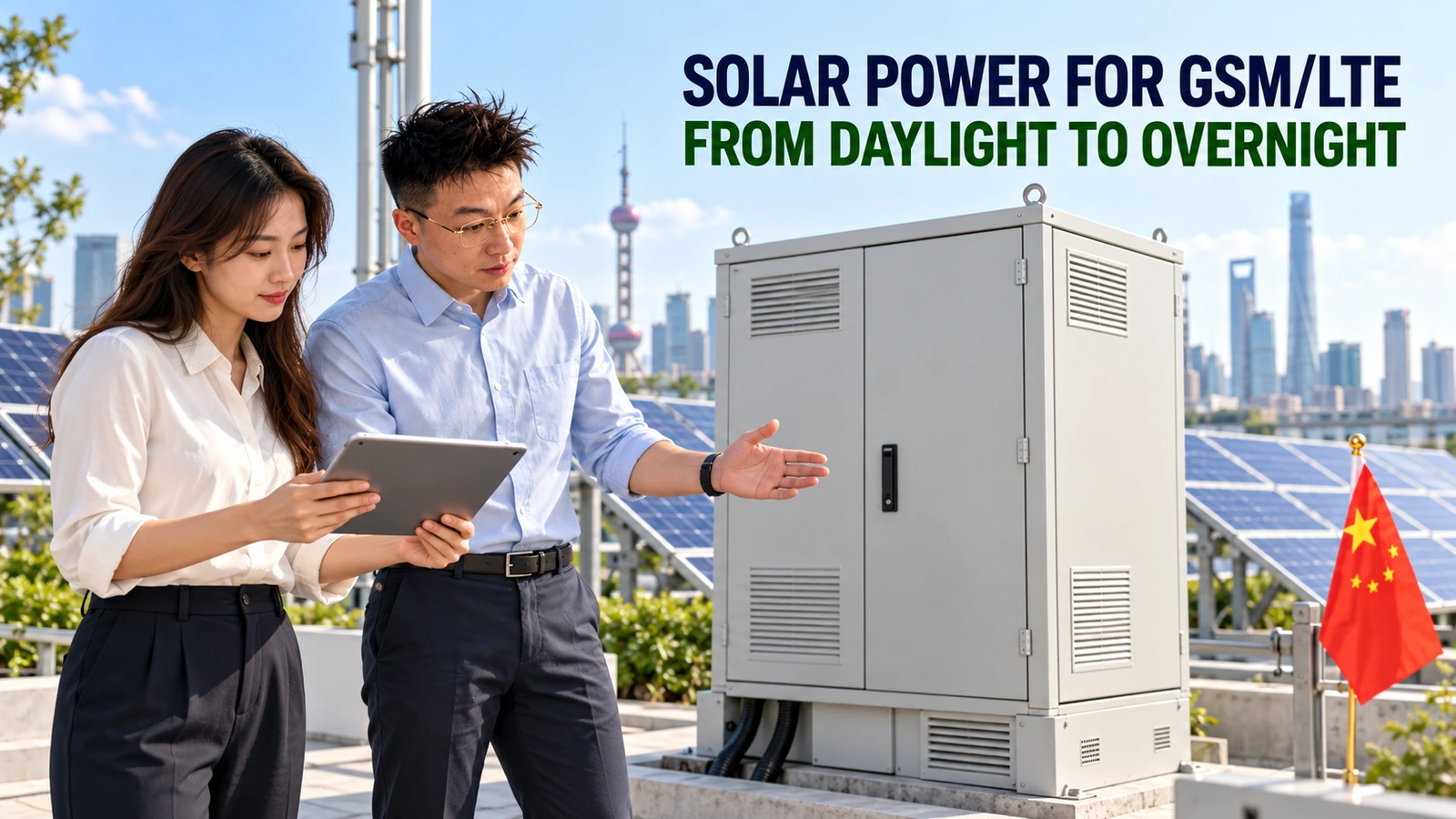
Engineers review a tablet beside a closed telecom energy cabinet and solar panels at a conceptual Shanghai demonstration site with a Chinese flag.

When is a solar system the primary supply for a base station?

A solar system provides telecom primary power when solar generation and its associated storage are intended to carry the station’s normal operating demand. If the battery supplies the radios every night as part of that arrangement, it is performing an everyday supply task. Its involvement does not turn the installation into a backup-only system. Backup duty begins with another source normally running the station. A standby battery then carries the load during an interruption. A battery used for routine overnight operation faces a different pattern of discharge and recharge, even if its enclosure looks similar to a battery selected for outage protection. This distinction matters because a reserve that covers an occasional interruption does not automatically suit recurring overnight use. The solar installation has to support the running load and replenish the energy withdrawn from storage. Whether utility power or another source is also permitted is a separate architecture decision; the off-grid telecom power guide covers those supply options.

Follow a normal day and night of site operation

The relationship between generation, load and battery charging changes during the day. The following sequence describes a solar-and-battery supply without assuming that every day is clear or that the battery is full at sunset. The selected controller and conversion equipment determine how the actual installation manages these power flows.

Daylight: serve the running load and charge when energy is available

In suitable daylight conditions, the PV array delivers power through the system’s solar conversion and charge-control equipment. The station continues consuming energy while the battery charges. Solar power available beyond the simultaneous load can be used for charging, subject to the equipment’s charging and operating limits. Sunlight does not mean the battery must be charging. A shaded array, a passing cloud or an increase in site demand can leave generation below the running load. The battery may then contribute power during the daytime as well. Charging depends on the available surplus, rather than simply on whether the sun is visible.

Evening and overnight: stored energy carries normal demand

As PV production falls, the battery can supply more of the station’s demand through the appropriate power path. After sunset, stored energy can support the radios and associated equipment even though the array is no longer producing useful power. This solar battery operation is part of the planned operating cycle. Storage shifts energy from the time it is generated to the time it is needed. The U.S. Department of Energy’s solar and storage explainer describes this function and notes that storing and retrieving energy involves losses. The energy delivered back to the equipment is therefore less than the energy originally used to charge the battery.

The next day: restore the energy used while the station keeps running

Morning solar production does not immediately restore the battery to its previous charge level. The operating load still needs power, and charging is limited by the surplus generation and the permitted charge rate. A site can resume solar-powered operation while its battery remains partly depleted. That is why adding storage alone cannot solve a persistent generation shortfall. A larger battery can hold more usable energy, but that energy still has to come from somewhere. If successive operating cycles withdraw more energy than they replenish, the stored reserve falls until the system can no longer support the intended load without another available source or a reduction in demand.

Why can a sunny location still have a power shortfall?

A sunny location can still have a power shortfall because sunshine, useful PV output and the load’s timing are different things. A station consumes energy outside productive solar hours, while shading, seasonal conditions, equipment limits and losses affect how much generation can reach the load or be stored. Sunny weather is an advantage, but it does not establish a complete daily energy balance. An annual generation estimate can hide that timing problem. Energy produced during a strong solar period cannot be assumed to remain available indefinitely for a later weak period. The relevant storage is finite, and surplus generation that the system cannot accept or store is not an overnight reserve. The official PVWatts guidance on interpreting estimates explains that typical-weather results are more useful for long-term performance than for predicting a particular month or year. It also cautions that site conditions such as shading can make default estimates optimistic. A solar-yield estimate is a useful input, but it does not by itself calculate whether this station’s battery can supply every low-generation interval. The engineering task is to match generation, demand and usable storage over time, including an agreed allowance for poor-solar conditions and recovery. Detailed capacity work belongs in the telecom solar sizing guide.

Continuous service does not require a constant power demand

A requirement for continuous operation means the base station must remain energized through the required service period. It does not mean its power draw is identical at every moment. Radio activity, equipment operating states and auxiliary demand can change while the site remains in service. Cooling is one reason the complete site demand can differ from the radios’ demand alone. Transport equipment, controls and other auxiliaries also consume energy. Together, these make up the total site demand, even when some auxiliaries operate intermittently. A power figure covering only the radio equipment may therefore understate the duty of the energy system. A constant-power model is a useful simplification, but it is not the same as a measured demand profile. A change in daytime cooling demand, for example, can reduce the solar power available for charging even when the radio load has barely changed. The form of the output also matters. PV modules produce direct current (DC), but their output is not automatically suitable for direct connection to any radio or battery. The system needs compatible control, conversion and protection. Where alternating-current (AC) auxiliaries are included, the supply must also provide an appropriate AC path and account for its conversion losses. The telecom power component guide explains those equipment roles in detail.

Do several radio base stations need identical power systems?

Several radio base stations (RBSs) do not necessarily need identical solar and battery systems. Stations using similar radio equipment can still have different auxiliary loads, shading, available array space and local weather. Their energy needs must be related to the conditions at the installations they serve. The number of RBSs alone therefore does not determine the required generation or storage. Two locations can have similar average demand but different overnight consumption or usable solar production. Copying one configuration across both may leave one site with a substantially different operating margin. Separate locations may have independent energy systems, while a shared supply can serve more than one RBS where that arrangement is designed for the loads and connections involved. Huijue’s team in Shanghai, China, provides configurable telecom solar equipment and integration for site-specific energy projects.

Power the site through its daily cycle

A site load profile, location and available PV area provide a starting point for assessing how solar generation, storage and conversion equipment would work together in normal service. The useful result is a preliminary supply concept that explains daytime operation, overnight supply and battery replenishment under the proposed site conditions. Discuss your site