Remote Is a Service Condition, Not a Map Label
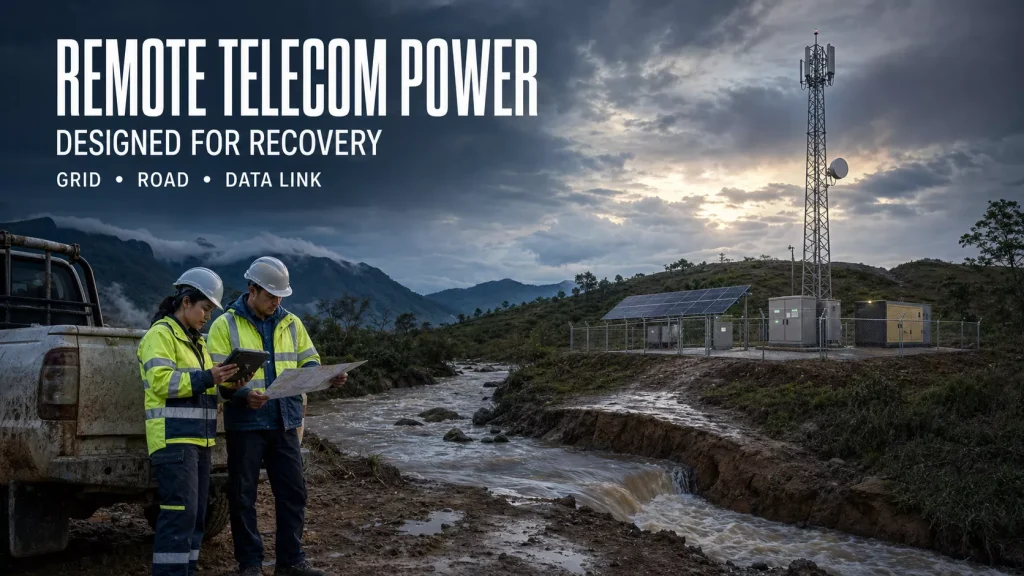 A tower does not need to be hundreds of kilometres from a city to be operationally remote. A rooftop behind a slow permit process can have a longer repair time than a rural roadside mast. A mountain site may have excellent satellite telemetry but no safe winter access. An island site may have reliable sunshine and an unreliable spare-parts route.
Treat remoteness as several separate constraints:
A tower does not need to be hundreds of kilometres from a city to be operationally remote. A rooftop behind a slow permit process can have a longer repair time than a rural roadside mast. A mountain site may have excellent satellite telemetry but no safe winter access. An island site may have reliable sunshine and an unreliable spare-parts route.
Treat remoteness as several separate constraints:
| Remote condition | Question to ask | Power-system consequence |
|---|---|---|
| Energy remoteness | How often and how long are usable grid, solar, fuel or other sources unavailable? | Sets source diversity, reserve energy and recovery-generation needs |
| Access remoteness | What is the longest credible travel and site-entry delay in each season? | Extends the period the system must tolerate a fault without intervention |
| Information remoteness | Can the site still report and accept safe commands when its primary backhaul fails? | Requires local autonomy, trustworthy event records and possibly an independent path |
| Technical remoteness | Which repairs can the available field team complete with its tools and training? | Influences module size, connectors, bypass arrangements and documentation |
| Supply-chain remoteness | Where are critical spares, and what happens at customs, ports or regional depots? | Changes stocking policy, standardisation and acceptable component lead time |
| Environmental and security exposure | Which heat, cold, dust, salt, lightning, flooding, theft or vandalism events are credible? | Shapes enclosure, protection, grounding, cooling and physical-security choices |
Where Remote Telecom Power Demand Is Strongest in 2026
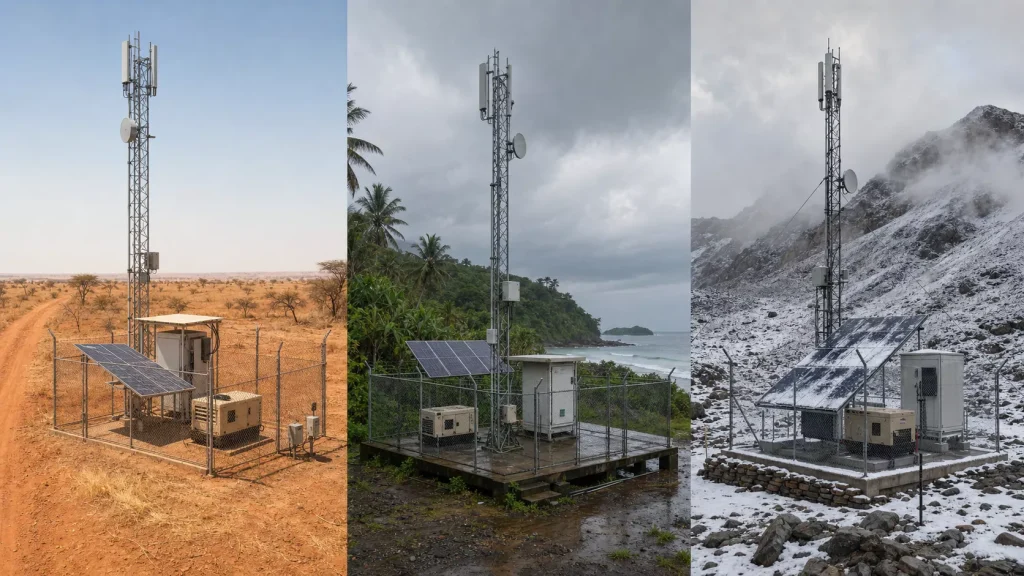 Remote telecom power is not a single standard package. Dust, flooding, salt exposure, temperature and site access change the enclosure, solar array and backup-power design.The countries with the greatest technical need are not always the easiest markets to serve. A large rural coverage gap may create demand for new sites, while foreign-exchange constraints, slow customs clearance or a weak service network make the power project difficult to finance and maintain. Conversely, mature mobile markets may build fewer new remote towers but spend more per site on resilience, replacement and regulatory evidence.
The ITU’s Facts and Figures 2025 estimates that 2.2 billion people remain offline. It also reports a persistent urban-rural divide and much lower 5G coverage in low-income countries. These figures do not translate directly into a tower forecast: affordability, spectrum, backhaul and operator economics also decide whether a new site is viable. They do show where coverage expansion and dependable low-operating-cost infrastructure remain important.
Remote telecom power is not a single standard package. Dust, flooding, salt exposure, temperature and site access change the enclosure, solar array and backup-power design.The countries with the greatest technical need are not always the easiest markets to serve. A large rural coverage gap may create demand for new sites, while foreign-exchange constraints, slow customs clearance or a weak service network make the power project difficult to finance and maintain. Conversely, mature mobile markets may build fewer new remote towers but spend more per site on resilience, replacement and regulatory evidence.
The ITU’s Facts and Figures 2025 estimates that 2.2 billion people remain offline. It also reports a persistent urban-rural divide and much lower 5G coverage in low-income countries. These figures do not translate directly into a tower forecast: affordability, spectrum, backhaul and operator economics also decide whether a new site is viable. They do show where coverage expansion and dependable low-operating-cost infrastructure remain important.
| Region and example markets | Where demand comes from | Likely project mix | Remote-power priority |
|---|---|---|---|
| Sub-Saharan Africa: Nigeria, Democratic Republic of the Congo, Ethiopia, Kenya, Tanzania, Uganda and Mozambique | Rural coverage expansion, unreliable or absent grid supply, tower-company growth and pressure to reduce delivered diesel cost | Both greenfield rural sites and brownfield conversion of diesel-heavy, lead-acid or poorly monitored installations | Fuel displacement, long recovery intervals, theft resistance, regional spares and controls that operate without permanent backhaul |
| South and Southeast Asia: India, Pakistan, Bangladesh, Indonesia, the Philippines and Papua New Guinea | Large subscriber bases, 4G/5G expansion, islands and mountainous settlements, monsoon and cyclone exposure, and uneven grid quality | High-volume brownfield modernisation in mature networks; selective new coverage in islands, border areas and difficult rural terrain | Compact modular systems, flood and salt protection, cooling efficiency, local certification and a service chain that crosses islands or remote provinces |
| Latin America: Brazil, Peru, Colombia, Mexico and Bolivia | Amazon, mountain and agricultural coverage, public connectivity programmes, mining and transport corridors, and growing 4G/5G demand | New rural and private-network sites alongside upgrades to ageing diesel, battery and monitoring systems | Transportable modules, seasonal access planning, lightning protection, autonomous control and clear responsibility across operator, towerco and EPC |
| Middle East, North Africa and Central Asia: Saudi Arabia, Oman, Morocco, Egypt, Kazakhstan, Mongolia and Uzbekistan | Desert highways, oil and gas operations, mines, border coverage, smart infrastructure and long-distance transport networks | New private or corridor networks plus resilience and efficiency upgrades to established macro sites | High-temperature derating, dust control, battery thermal management, long logistics routes and low-maintenance generation |
| North America, Europe, Australia and New Zealand | Public safety, rural broadband, rail, utilities, mountain sites, wildfire and severe-weather resilience rather than broad lack of grid access | Mostly brownfield resilience work with selective new sites in remote communities, parks, transport routes and critical infrastructure | Documented availability, environmental compliance, cybersecurity, approved supplier routes and integration with existing generators and DC plants |
New-build and upgrade projects fail in different ways
A greenfield site offers freedom to align PV, storage, generation, DC distribution and enclosure design from the beginning. Its weaknesses are uncertain load growth, limited field data and pressure to minimise first cost. The project should preserve practical expansion paths without installing every future module on day one. A brownfield site provides measured consumption and fault history, but inherits old breakers, cable routes, grounding, generators, batteries and management interfaces. Replacement work may need temporary power while live services are migrated. The cheapest new cabinet is not necessarily the lowest-risk option if it forces avoidable civil work or cannot exchange alarms with the existing NOC. Across the regions above, the strongest near-term opportunity is therefore not one product. It is a portfolio split: build complete power plants for uncovered locations, hybridise sites that still burn diesel as the primary source, replace ageing storage and rectifiers where load has grown, and harden critical sites whose original backup assumptions no longer match climate or repair time.Geopolitics Can Change Which Product Is Eligible
Remote power procurement now sits close to telecom security policy. The important word is close. A steel enclosure, battery rack or rectifier is not automatically covered by a restriction written for radio access, routing or core-network equipment. The analysis changes when the power cabinet includes a cellular modem, remotely administered gateway, surveillance function, vendor cloud or software component with privileged network access. As of August 2026, buyers should recognise several different policy approaches:- United States: the FCC’s June 2026 Covered List includes specified telecommunications and video-surveillance equipment and services from named entities, including Huawei and ZTE. Federal contracts and funded projects can add separate clauses. The exact product function, producer, affiliate and intended use matter.
- European Union and United Kingdom: EU Member States apply national measures alongside the 5G Cybersecurity Toolbox; the European Commission has stated that decisions to restrict or exclude Huawei and ZTE are justified under its high-risk-supplier assessment. The UK requires Huawei equipment to be removed from 5G networks by the end of 2027. Product conformity, such as CE documentation, does not by itself establish network-supplier eligibility.
- India: the telecom framework provides for designated categories to use trusted products from trusted sources and allows authorities to specify persons from whom procurement cannot occur. Security testing and certification may apply separately. An overseas OEM should confirm the current category, portal and certification route before fixing the bill of materials.
- Public safety, development-finance and critical-infrastructure projects: contract terms may be narrower than the general commercial market. They can add country-of-origin, data-location, cybersecurity, local-content or approved-vendor requirements even where a private operator would accept the same equipment.
Follow the Whole Availability Chain
Remote telecom power reaches the load through a chain: source, input protection, conversion, DC distribution, cabling and the telecom equipment itself. Storage supports that chain. Controllers and sensors decide how it behaves. Cooling and enclosure conditions determine how long the components can perform their job. Adding more sources does not automatically create resilience. Solar, grid and a generator can all become unavailable if one common controller locks up. Two battery strings offer limited protection if they share an undersized breaker or sit in the same overheated cabinet. A redundant rectifier shelf is not useful when a single damaged DC distribution bar disconnects every module from the load.Engineering rule: site availability depends on energy adequacy, fault isolation and recovery capability. Improving only one of the three can leave the outage mechanism unchanged.
Draw the power chain as failure domains rather than product boxes. Mark every common point that can stop more than one source, every protection device that needs manual reset and every control function that depends on an external server. This exercise often finds a cheaper reliability improvement than adding another battery rack.
The ITU-T L.1380 smart-energy recommendation provides a useful reference for coordinated control of multiple energy sources at telecom sites. The project still needs a site-specific failure analysis: a standard describes functions and interfaces, while the operator defines the service consequence of losing them.
Size the Recovery Envelope, Not Just Battery Hours
Battery autonomy normally answers one question: how long can stored energy carry a defined load? A recovery envelope asks a broader one: how long must the site maintain an acceptable service while the fault is detected, understood, reached, repaired and followed by a controlled recharge? Recovery interval = detection and diagnosis + dispatch approval + travel and access + repair + restart and recharge margin The credible interval changes by season. A four-hour response target in dry weather may become 48 hours when a river crossing is closed. If the design uses the annual average response time, it may be least prepared on the day it is most needed.A 48-hour minimum-service example
Consider a remote base station with a measured normal load of 3.2 kW. Network engineering approves a minimum-service mode of 2.4 kW for a declared emergency window by shedding non-essential site loads and reducing selected capacity without removing required coverage or emergency functions. Over 48 hours:- Full-service delivered energy is 3.2 kW × 48 h = 153.6 kWh.
- Minimum-service delivered energy is 2.4 kW × 48 h = 115.2 kWh.
- The difference is 38.4 kWh before conversion losses, battery limits and ageing allowances.
Six Failure Cases That Expose a Weak Design
Specifications often describe normal source priority in detail and say little about abnormal combinations. Remote sites spend their hardest hours in those combinations.| Failure case | Hidden problem | Desired response |
|---|---|---|
| Solar or grid energy remains below forecast | The controller repeatedly waits for a source recovery that does not arrive | Use forecast-aware thresholds, protect minimum reserve and start recovery generation before the battery reaches a damaging state |
| One battery branch or BMS becomes unavailable | A common communication fault or protection setting removes every parallel battery | Isolate the affected branch, keep healthy branches online where safe and issue an alarm that identifies the failed layer |
| The generator fails its first start | Repeated cranking consumes starter energy while fuel, lubrication or temperature faults remain unresolved | Use a limited, timed retry sequence; preserve starting reserve; escalate clearly; avoid endless automatic attempts |
| A rectifier module or main controller fails | Redundant modules exist, but one shared control or distribution point stops the shelf | Maintain the critical DC bus in a defined fallback mode and make the failed module replaceable without a full-site shutdown |
| Telemetry disappears | The NOC cannot tell a communications failure from a power failure and sends the wrong response | Continue safe local control, retain time-stamped events and restore them through store-and-forward when the link returns |
| Lightning or a surge damages one interface | Protection is fitted at the cabinet but not coordinated across PV, generator, grid, antenna and data entries | Use coordinated protection and bonding, isolate the damaged path and preserve unaffected sources where the architecture permits |
Design Graceful Degradation and a Real Black Start
A robust site does not move directly from normal operation to darkness. It steps through known states.- Normal mode: all approved loads operate and sources follow the economic control sequence.
- Conservation mode: optional cooling, maintenance outlets or other agreed auxiliary loads are reduced.
- Minimum-service mode: the network follows a pre-approved service profile while energy reserve is protected.
- Protection mode: the controller prevents unsafe battery discharge, unstable source cycling or equipment damage.
- Recovery mode: sources, batteries and loads return in a sequence that does not overload the generator, rectifier or weak grid connection.
Make the Site Repairable With the Team That Will Actually Arrive
Maintainability begins before installation. A technically elegant cabinet can be a poor remote-site product if a failed module needs a lifting device that is not available, a proprietary laptop adapter or a cable that is stocked only at headquarters. Field-oriented design checks include:- Keep regularly replaced modules within safe local handling and lifting limits.
- Provide front access where rear clearance will disappear after the compound is built.
- Use durable terminal, breaker and cable labels that match the as-built drawing.
- Standardise connectors and module families across a defined site class.
- Store the correct firmware, configuration and recovery procedure for offline use.
- Place diagnostic indicators where they can be read without exposing live conductors.
- Specify corrosion-resistant hardware and insect, dust and water control for the actual environment.
- Record the tools, PPE and skills required for each replaceable unit.
When the Site Goes Silent, Local Control Must Keep Working
Remote monitoring is essential, but remote telecom power should not depend on continuous remote monitoring to remain safe. The same storm, transmission fault or site outage can remove the data path used to report the energy problem. At minimum, the site should retain local source control, alarm states and time-stamped event history during a communications loss. A heartbeat lets the NOC distinguish silence from a normal low-alarm period. Store-and-forward records preserve the sequence of events instead of sending only the final state after reconnection. Remote commands need a separate review. Role-based access, authenticated sessions, command logging, sensible timeouts and a safe local fallback matter more than a colourful dashboard. A stale cloud command should not restart a generator or change a battery limit after site conditions have moved on. The site’s dashboard should concentrate on decisions rather than repeat every available register. The companion guide to telecom energy monitoring KPIs covers availability, battery, energy, cabinet and alarm measures in more detail. For a remote site, add one more question to every KPI: can the field team act on it before the recovery envelope expires?Commission the System by Breaking It on Purpose
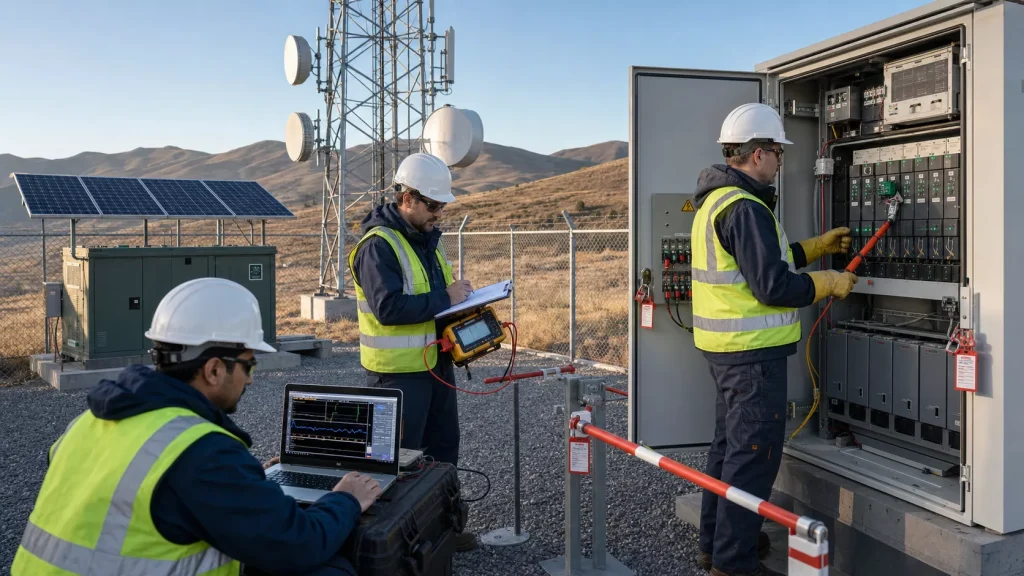 A credible acceptance test records voltage, current, alarms and transition times while engineers deliberately isolate sources, battery branches and the remote data path.A remote site should not receive final acceptance after a sunny-day run and a screenshot of normal alarms. Controlled fault tests reveal whether the written recovery sequence exists in the installed system.
| Acceptance test | Evidence of a credible pass |
|---|---|
| Remove the primary source at representative load | No critical-load interruption; correct source state, alarm and energy forecast are recorded |
| Isolate one battery branch | The fault is contained, remaining capacity is recalculated and the alarm identifies the branch |
| Force the first generator start to fail | Retry limits, escalation and starter-energy protection follow the approved sequence |
| Restart the energy controller | Critical DC remains stable; configuration, clock and operating state recover correctly |
| Disconnect the remote data path | Local operation continues; events are retained and delivered in order after reconnection |
| Black-start from a fully de-energised state | Control, sources, charging and loads energise in a stable, documented sequence |
| Restore grid or generator power at low battery SoC | Charge current and load restoration stay within source, rectifier and battery limits |
| Operate in approved minimum-service mode | Measured load reduction matches the energy model without losing protected services |
Price Truck Rolls and Recovery, Not Only Hardware
The lowest-capex remote telecom power option can become expensive when it creates repeat visits. Its lifecycle cost should include scheduled maintenance, unscheduled dispatch, fuel and transport, spare inventory, energy losses, battery replacement, software support, downtime exposure and end-of-life handling. Remote-site lifecycle cost = installed cost + energy and fuel + planned maintenance + expected fault recovery + replacement and disposal + service-risk allowance A simple fleet calculation makes maintainability visible. If a design change avoids 0.6 unscheduled visits per site each year across 120 sites, it prevents 72 dispatches annually. Multiply 72 by the fully loaded cost of one dispatch, including travel, labour, security, permits and lost time. That value can be compared with the added cost of better diagnostics, modular spares or a more resilient controller. Do not assume every alarm avoided is a truck roll avoided. The benefit exists only when remote diagnosis is trusted, the system can enter a safe state and the field action can wait until a planned visit. Operations and maintenance should therefore be considered during design, not appended after commissioning. The US National Renewable Energy Laboratory’s PV and energy-storage O&M best-practices report makes the same broader point for solar assets: deployment quality and maintainability influence lifetime performance and cost.What to Put in a Remote Telecom Power Project Brief
Before asking for a cabinet or bill of materials, give bidders a service problem they can design against:- Service target: required availability, protected network functions and approved minimum-service mode.
- Measured load: normal, peak, seasonal and planned future DC and AC demand.
- Source record: grid outages, solar resource by design period, fuel access and generator constraints.
- Recovery interval: credible detection, dispatch, travel, repair and recharge time by season.
- Failure behaviour: required isolation, degraded modes, source priority and black-start sequence.
- Environment: temperature, humidity, dust, salt, lightning, flooding, altitude and security exposure.
- Maintainability: field skills, tools, handling limits, regional spares and target repair time.
- Monitoring and security: local autonomy, retained data, interfaces, remote roles and command audit.
- Acceptance evidence: calculations, drawings, settings, test traces, training and as-built records.
- Lifecycle boundary: energy, maintenance, software, battery replacement and disposal responsibilities.